The Questors Archive logo

MUCH ADO ABOUT NOTHING
by William Shakespeare

The Questors Playhouse
March 2007

Directed & Designed by
Steve Fitzpatrick
Choreography by Frances Whittaker
Original music composed by
Yaron Hollander
Lighting design by Andy Torble
Sound design by Alan Smith
Costume design by Sarah Andrews


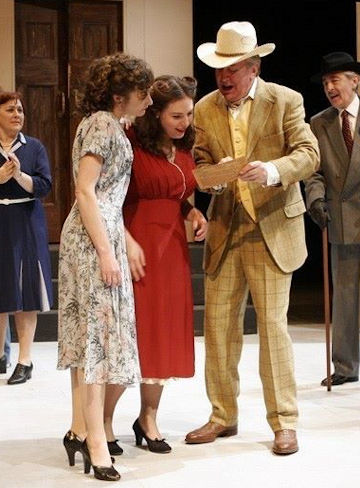
muchado02.jpgmuchado04.jpgmuchado03.jpgmuchado05.jpg
muchado14.jpgmuchado06.jpgmuchado09.jpgmuchado10.jpg
muchado12.jpgmuchado13.jpgmuchado01.jpgmuchado16.jpg

Cast:
Assisi Azzorpardi, Katy Baggs, Robert Baker-Glenn, Sarah Beebe, Howard Benbrook, Hainsley Bennett, Stephanie Boyle, Tony Bromham, Julian Casey, Sunita Dugal, Jemma Edmunds, James Ellis, Russell Fleet, Andrea Gray, Martin Halvey, David Hovatter, Claudia Kailich-Ofner, Sarah Morrison, Mark Oosterveen, Nikki Squire, Ian Stirling, Derek Stoddart, Rosalind Storey, Matilda Tucker, Paul Vincent, Alexis Wieroniey

Production Team:
Sarah Andrews, Claire Auvache, James Bromfield, Jim Craddock, Andrew Davies, Charlotte Drew, Arthur England, Kate Gardiner, Richard Halberstadt, Michael Hayes, Yaron Hollander, Francois Langton, Jovanka Litvinenko, Sarah Parkinson, Caroline Phelan, Beth Pitman, Alison Pollard, Jack Richardson, Alan Smith, Andy Torble, Diane Valtisiaris, Claire Walker, Frances Whittaker, Richard Williams,


Programme
programme.PDF
   

William Shakespeare at The Questors
Much Ado About Nothing 1946, 1993, 2007

DIRECTORS' NOTES

Shakespeare wrote Much Ado About Nothing in 1598 or 1599. It was first printed in 1600, in a good text that seems to be based on Shakespeare’s own manuscript. Judging from contemporary references it appears to have been popular from the start.

The story of the love between Hero and Claudio, and the cruel deception that disrupts it, is based on an old story told by many sixteenth century writers. The more benign deception practised upon Benedick and Beatrice has no known source and may well be Shakespeare’s own invention.

But the stroke of genius was to combine two plots so different in tone and mood in the one play, creating two contrasting love-stories, which reflect back and forth upon each other to create one of the most profound and entertaining explorations ever written of what it means to be ‘in love’, and of the difficult and often painful road towards mutual trust and sincerity.

Hero and Claudio are the more conventional, ‘romantic’ pair of lovers. Critics never fail to point out that they speak to each other exclusively in verse, whereas Benedick and Beatrice converse in prose. More importantly, unlike Benedick and Beatrice, who are so voluble that they might ‘talk themselves mad’, Hero and Claudio barely speak to each other at all. In fact, Hero hardly ever opens her mouth in the presence of any man, although when we hear her alone with her women-friends, she is both articulate and witty. And Claudio does not even woo Hero in person: Don Pedro does it for him – something that causes great confusion all round, as Leonato, Antonio and Benedick all assume that Don Pedro wants her for himself, and it needs little persuasion for even Claudio to think the same.

These misunderstandings and confusions, so brilliantly symbolised by the disguised couplings and re-couplings of a masked ball, are fairly easily resolved, but the lack of trust and mutual understanding that is revealed goes to the heart of the play. It is hardly a surprise when Claudio and Don Pedro are so easily tricked into doubting Hero, for neither of them has taken much trouble to understand or get to know her.

Benedick and Beatrice are mistrustful of each other for a different reason: they know each other only too well, but they do not know themselves. They have a prior history – Beatrice says that once before he won her heart ‘with false dice’ – and the mistrust and resentment stemming from that experience has poisoned their relationship not only with each other but with the whole opposite sex. Even after they are tricked into realising their true feelings for each other, they remain ‘too wise to woo peaceably’, and the hurt of previous betrayals remains tangible. It is not just Claudio’s rejection of Hero that makes Beatrice demand that Benedick prove his love for her in the most extreme way imaginable, but also Benedick’s own previous rejection of Beatrice, and the constricted role in life to which her gender condemns her.

But this is a comedy, not a tragedy, and providence is on hand to provide a happy ending. And happy endings don’t come much more providential than this one, for it is supplied by the most incompetent policeman in all literature, the bumbling Dogberry and his equally hapless Watch, who foil the plot and unmask the villains without ever quite realising what they have done.

The ending of the play is one of the most joyous in all Shakespeare: there is no Malvolio or Jaques to cast an acerbic eye on the celebrations, and all the ado ends as it began: in that most elemental of mating rituals – a dance.

Steve Fitzpatrick