QUESTSTORIES
THE QUESTORS NEW PLAYS FESTIVAL
4th FESTIVAL 1963
DON'T WAIT FOR ME


DON'T WAIT FOR ME
by David Campton

Directed by John Miles-Brown
Cast:
Sheila Bray, Wendy Jolly, Mary Jones, Myles McDowell, Margaret Parry,

THE AUTHOR

David Campton (1924–2006) was a prolific British dramatist who wrote more than a hundred plays and sketches, as well as work for radio and television. Born in Leicester, he became closely associated with Stephen Joseph and the development of theatre-in-the-round at Scarborough. The subtitle of Campton’s The Lunatic View inspired critic Irving Wardle’s influential term “comedy of menace”, frequently applied to Campton’s early work and that of Harold Pinter. 

Two of his plays appeared in the New Plays Festivals: Don’t Wait for Me in 1963 and The Life and Death of Almost Everybody in 1970. The latter became one of his most widely performed works. 

The Questors’ Student Group subsequently presented his play The Cagebirds in 1985.

David Campton on WIKIPEDIA 

.

THE PLAY

David Campton's play was performed on the same evening as the James Saunders' plays. It was not the first time these two authors had shared a bill, as it happened at the Comedy Theatre in 1961 when they both shared the evening with Harold Pinter. 

In this piece the author leaves the style of 'comedy of menace' for which he was best known, to write a straightforward play of character.

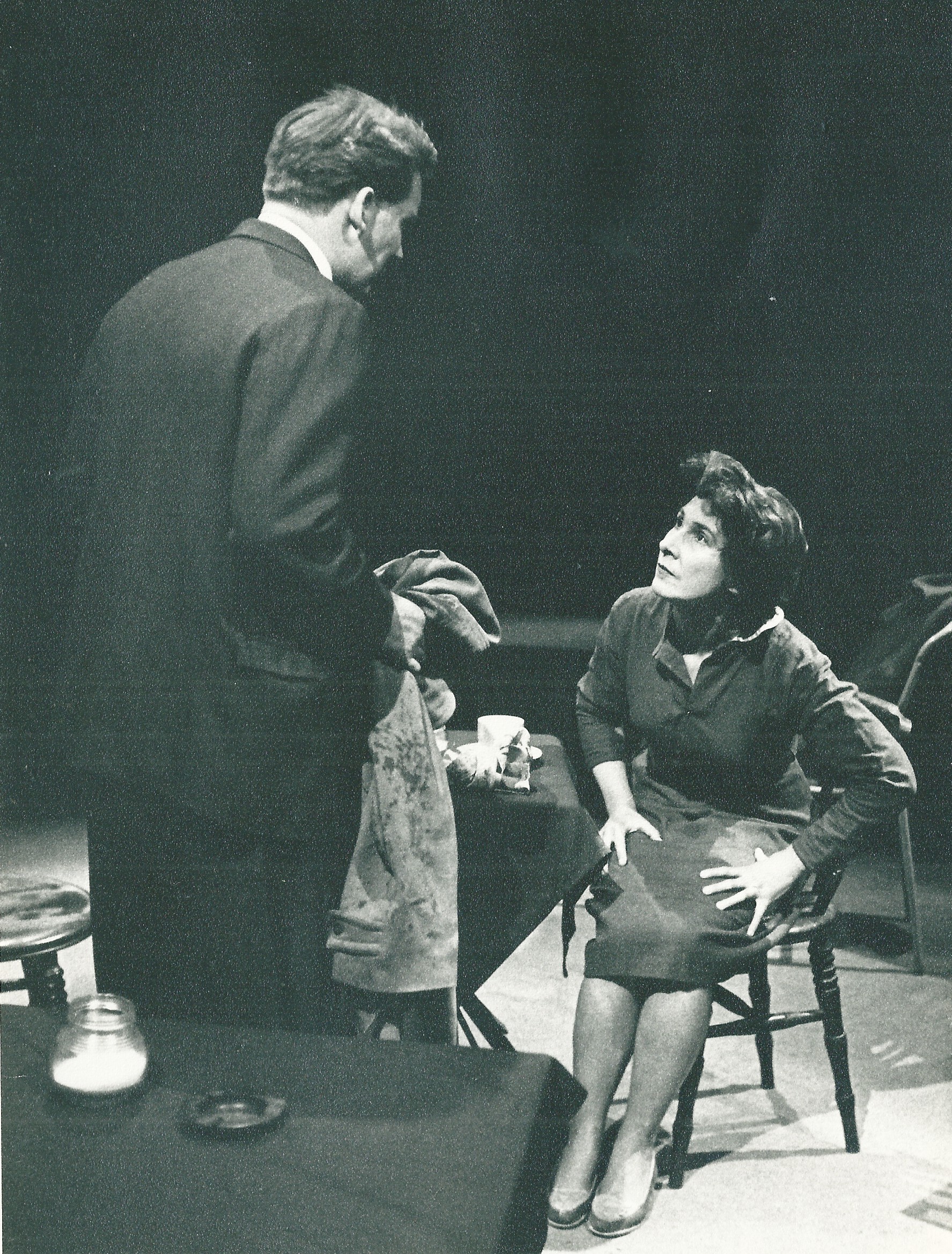
PRODUCTION PHOTOS

Extract from Festival News (Alfred Emmet)
"David Campton was able to look in recently at a rehearsal of his play "Don't Wait For Me", in which Liz and Eddie are being played respectively by Mary Jones, her first part for The Questors, and Myles McDowell, who has had to sacrifice for it his magnificent growth of beard. He goes about the theatre unrecognised.

"Margaret Taylor and Sheila Bray complete the cast, with student Wendy Jolly as the small girl."
PRESS RESPONSE
 

David Campton’s departure from his usual comedy of menace produced divided but predominantly muted reactions. Kenneth Tynan dismissed the play as a “thin-blooded novelette,” while The Stage found it disappointingly old-fashioned and reminiscent of a women’s-magazine story. Amateur Stage likewise considered the characters superficial. Douglas McVay in The County Times was more sympathetic, finding the piece modest and sentimental but crediting it with a genuine melancholy impact.

  • Amateur Stage
  • The Middlesex County Times
  • The Observer
  • The Stage and Television Today
  • West London Star

  • QUESTORS ARCHIVES
    DON'T WAIT FOR ME