QUESTSTORIES
THE QUESTORS NEW PLAYS FESTIVAL
3rd Festival 1962
THE CHILDREN OF SATURN


THE CHILDREN OF SATURN
by Lydia Ragosin

Directed by Kenneth Connington
Cast:
Carol Adams, Jeannette Ambrose, Anthony Bosworth, Martin Bowley, Alan Chambers, Awen Griffiths, Anthony Harrison, Anthony Holloway, Brian Horry, David King, Michael Langridge, Wylie Longmore, David Lorraine, Elaine McCann, Martin McDonald, Myles McDowell, Bernard McLaughlin, Thomas Mercer, Gillian Padfield, Margaret Parry, John Turner, Sandra Turner

THE AUTHOR

Lydia Ragosin was born in London of Russian parents. Her mother was Lydia Kyasht, "The World's Most Beautiful Dancer", her father a Colonel in the Guards, who himself went through the 1905 revolution in St. Petersburg. Lydia began writing for the theatre in 1948. Her first theatre play was "Tinsel of Athens" which The Questors staged in 1950. That was also the year her first radio play was broadcast by the BBC. Her second radio play was "The English Captain", which The Questors staged in its stage version in 1955.

  • Lydia Ragosin's plays at The Questors

  • THE PLAY

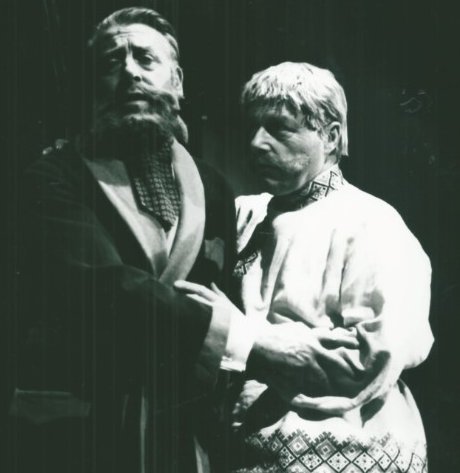
    This stage version of The Children of Saturn was commissioned by The Questors following its successful broadcast as a radio play earlier in the year. Set in St. Petersburgh at the beginning of this century, it deals graphically and dramatically with events of the 1905 Revolution, the corruption of the aristocracy and the revolutionaries alike and the ineffectualness of the liberals who might have saved the bloodshed. The central character is Volodya Barteniev, a young idealist who is devoured by the Revolution, like the children of Saturn.

    The Children of Saturn
    has the distinction of being the last play to be performed in the Questors' "old tin hut" theatre before it was demolished.

    PRODUCTION PHOTOS

    A GOLDEN MOMENT FROM MICHAEL LANGRIDGE 
    The last production I was allowed in during my first year was a very memorable production in the New Plays Festival, a play called 'The Children of Saturn' - a title that brings tears to the eyes of many a member even now. One incident from this play that I remember vividly happened during a scene which re-created the storming of the Winter Palace by the peasants during the Russian revolution. The set for the play was divided into three sections, a drawing room at the front of the stage, an attic at one side and a large rostrum standing about five feet off the ground upstage. For some reason only known to the producer the peasants, of which I was one, had to negotiate armchairs, sofas and tables, etc. which remained on stage throughout the play, even in the outdoor scenes. The incident I am referring to occurred when the peasants entered following their leader Father Gapon. The cast of peasants numbered about twenty-five and before going on we had to line up outside the theatre (there were no wings in the old Theatre), sometimes in the pouring rain, having been called at least half an hour before we were due to go on. Eventually we got our cue, and we filed onto the stage; that is to say, some of us. Most of the crowd never got there, because of the size of the stage, and remained in the pouring rain, waving their icons for the duration of the scene. Those who managed to get in front of the audience did not last very long; they were instantly massacred by another two first-year students, who mowed them down to an unconvincing recording of gunfire, which seemed to have been extracted from the '1812'. At the sound of the guns, we had to fling ourselves into the cyclorama pit to clear for the next scene, and crawl out over broken gelatines and lights making sufficient noise to wake, not only the dead, but half the audience as well.

    PRESS REACTION
    Lydia Ragosin's account of the 1905 Russian Revolution earned respect for its sincerity and historical authenticity but was generally thought to lack dramatic power. The Stage admired the author's knowledge and ideals, although it found the episodic structure better suited to radio than the stage, while The Times praised several striking theatrical moments but considered the transitions between scenes awkward. Douglas McVay, in the Middlesex County Times, judged the play serious and literate but ultimately uninspired. 

  • The Middlesex County Times
  • The Stage and Television Today
  • The Times

  • QUESTORS ARCHIVES
    THE CHILDREN OF SATURN