
CIRCUSES
by James Hepburn
Directed by Geoff Webb
Cast:
Alfred Anderson, Glynn Caren, Liz Chisholm, Alan Chisholm, John Holloway, John Martin, Paul O'Connor, Norah Wade
THE AUTHOR
James Hepburn was an American scholar, teacher and writer whose work included literary criticism, memoir, children’s fiction, opera librettos and plays. A Yale graduate, he received his doctorate from the University of Pennsylvania and taught at several American universities before becoming a research fellow at the University of Leicester.
The Questors presented his first produced play, Poor Dumb Animals, in the 1971 New Plays Festival, followed by the specially commissioned Time, Life, Sex and You Know What in 1972 and Circuses in 1975. Hepburn later returned to America as Professor and Head of English at Bates College.
His association with The Questors continued with Moonshipt in 1977 and Men and Women in 1985.
THE PLAY
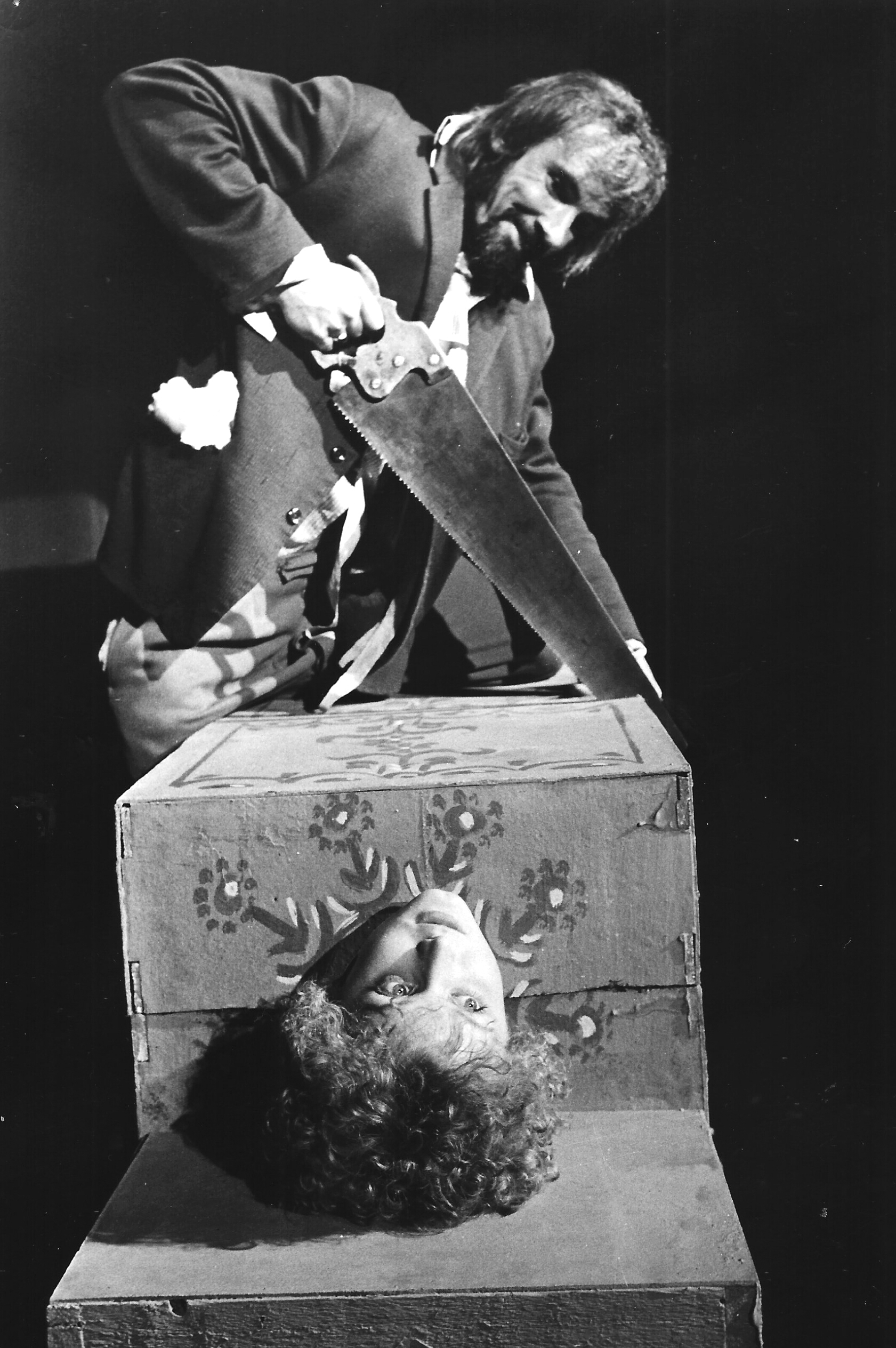 Circuses is not a conventionally plotted play but a rapidly changing sequence of short comic, strange and sometimes tragic pieces, performed by an ensemble without fixed characters. Sketches with such titles as “The Amazing Rudolph”, “Bakery Fakery”, “Hermann the Homunculus” and “Deaf Dumb & Blind” recur, overlap and develop variations upon one another.
The circus supplies an organising image rather than a definite setting, allowing Hepburn to combine revue, visual theatre, wordplay and the grotesque in an elusive theatrical collage. Its meaning depends less upon any single narrative than upon the cumulative effect of the individual episodes—and upon the different connections made by each spectator..
PHOTOS
PRESS RESPONSE
Circuses received the most consistently adverse response of the Festival. Most critics found its combination of variety entertainment, grotesque comedy and more serious symbolism bewildering rather than illuminating. Amateur Stage reported that the humour produced chiefly baffled silence and that no coherent purpose emerged from the recurring conflict between mankind’s physical and spiritual impulses. Anthony McCall in The Stage found the audience equally bemused and doubted that the work had a future without much clearer ideas and greater emphasis upon its humour and circus elements. Maurice Reeve in the Middlesex Chronicle called the music-hall turns embarrassingly naïve, while Nick Smurthwaite in the Thames Valley Times found some of the comedy tasteless and even offensive.Garry O’Connor in the Financial Times detected sharpness and polish in parts of the writing, notably the sketches “Hermann the Homunculus” and “The End,” but thought many of the remaining items fell flat and judged Circuses inferior to the Festival’s other plays.
The Gazette was somewhat more receptive to the slickness and American flavour of the first half and recognised more serious undertones in the second. The strongest defence came from Alan Chambers in Questopics, who believed that the umbrella title unhelpfully joined two essentially separate works. Although he found Magic ’n’ Tragic the less fully formed, Deaf, Dumb and Blind excited him considerably, revealing Hepburn as an elusive but genuinely poetic talent whose sensuous writing could create vivid effects on an almost bare stage.
The Middlesex Chronicle
The Stage
Amateur Stage
Thames Valley Times
Financial Times
The Gazette
QUESTORS ARCHIVES
CIRCUSES