
POOR DUMB ANIMALS
by James Hepburn
Directed by Cecil Hayter
Cast:
June Bowie, Barbara Butters, Val Caren, Roy Edwards, Richard Lewis, Diana Matthews, Peter Mcnamara, Paul O'Connor, Ken Ratcliffe, Gillian Redhead, Don Starkey
THE AUTHOR
James Hepburn was an American scholar, teacher and writer whose work included literary criticism, memoir, children’s fiction, opera librettos and plays. A Yale graduate, he received his doctorate from the University of Pennsylvania and taught at several American universities before becoming a research fellow at the University of Leicester.
The Questors presented his first produced play, Poor Dumb Animals, in the 1971 New Plays Festival, followed by the specially commissioned Time, Life, Sex and You Know What in 1972 and Circuses in 1975.
Hepburn later returned to America as Professor and Head of English at Bates College. His association with The Questors continued with Moonshipt in 1977 and Men and Women in 1985.
THE PLAY
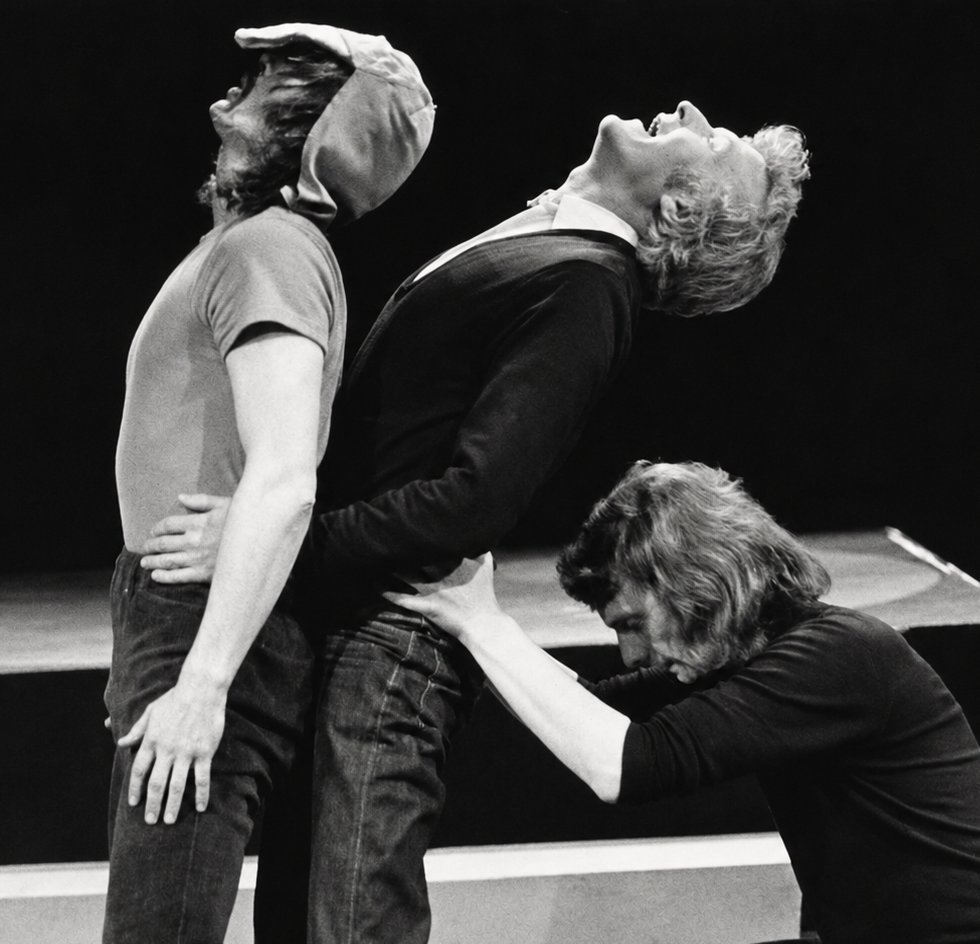 Poor Dumb Animals is an experimental sequence of five scenes rather than a continuous conventional narrative. Its episodes include Duck, Cow, Morning in the Life of Joseph and Joseph Worm, Ants in the Pants and Thirteen Ways of Looking at a Blackbird in Twelve Scenes, the last constructed around Wallace Stevens’s poem.
James Saunders called the work “weird” but perhaps genuinely original, and noted a Japanese influence. Through animals, fragmented human situations and shifting theatrical styles, the play appears to examine human behaviour from unfamiliar angles, blurring distinctions between the rational and instinctive, the comic and the disturbing.
PHOTOS
PRESS RESPONSE
James Hepburn’s sequence of five animal playlets was generally regarded as the most immediately entertaining contribution to the Festival, although reviewers agreed that its success varied considerably from scene to scene. Garry O’Connor in The Financial Times called it the Festival’s most talented and enjoyable play, praising its playful spirit, compassion and comic skill. The opening pieces, Duck and Cow, were the clear favourites: Amateur Stage thought them highly effective acting exercises, The Stage found them pleasingly diverting, and the Middlesex County Times reported that Duck provoked hysterical laughter. N.S. in the Brentford & Chiswick Times likewise found the spectacle of the actors impersonating ducks genuinely hilarious.
The later sections met with a more qualified response. The worms’ encounter with the descending blackbird’s beak was admired chiefly for Cecil Hayter’s staging and the striking lighting effect, while Ants in the Pants was variously described as anarchic and amusing, repetitive, profane or merely an opportunity for energetic movement. The concluding Thirteen Ways of Looking at a Blackbird in Twelve Scenes, based on Wallace Stevens, was almost universally considered overextended and less successful than the simpler sketches. Walter Lucas believed that excessive emphasis on movement obscured some genuinely thoughtful writing, but the broad consensus was that Hepburn’s wit and theatrical imagination were strongest when expressed briefly and directly.
Amateur Stage
The Brentford & Chiswick Times
Drama Quarterly
The Financial Times
The Middlesex County Times
The Stage and Television Today
QUESTORS ARCHIVES
POOR DUMB ANIMALS